Cute Sleepy Pets Clipart: A Designer’s Real-World Embroidery Review
First Impressions: Soft, Sweet, and Surprisingly Versatile
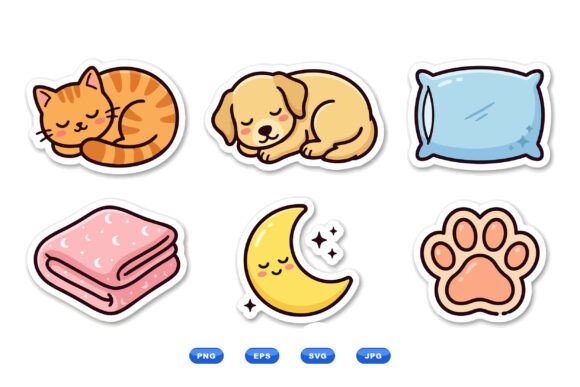
Opening Cute Sleepy Pets Clipart, I immediately felt the gentle mood shift — like stepping into a quiet nursery at dusk. The sleeping cat curled on a pillow, the puppy tucked beneath a crescent moon, the tiny paw beside a folded blanket — it’s pure kawaii calm, rendered in clean flat vector lines. No heavy outlines, no cluttered details, just joyful minimalism with warmth baked in. As an embroidery designer who’s stitched everything from boutique baby onesies to holiday market tote bags, I knew this wasn’t just “cute.” It was *curated* — designed for emotional resonance, not just visual appeal.
Where This Design Truly Shines (and Why)
I recently prepped a custom embroidered linen tea towel for a local children’s boutique — soft fabric, light stitching, gift-ready presentation. Cute Sleepy Pets Clipart landed perfectly there. Its open shapes and generous negative space translated cleanly into satin stitch borders and gentle fill-stitch zones. No dense thread buildup. No skipped stitches on the curve of the moon or the rounded ear of the sleeping puppy. On a 4x4 hoop, I used just the cat + pillow combo — simple, legible, and instantly recognizable even at 2.5 inches tall.
This design naturally fits embroidered patch work too. I tested it as a sew-on applique on a denim cap: the clean silhouette held up beautifully during trimming and turning. For custom apparel, it works best on relaxed-fit sweatshirts and lightweight cotton tees — not performance fabrics or ultra-thin voile, where fine details can blur. And for personalized gift projects? Think baby blankets, nursery wall hangings, or matching sibling pillow covers. The crescent moon + paw combo reads as peaceful, not playful — a subtle but meaningful distinction for parents seeking quiet, intentional decor.
What to Watch For (Because Real Fabric Isn’t Perfect)
Let’s be honest: not every surface welcomes kawaii charm equally. On stretchy fabric like ribbed knit onesies, I’d avoid the full sticker sheet layout — too many separate elements risk misalignment during hooping. Stick to one central motif (e.g., just the sleeping cat) and reinforce with medium-weight cutaway stabilizer. On dark fabric, white or pastel thread pops — but test contrast first. That crescent moon’s thin curve? It can vanish if stitched in charcoal gray on navy. Likewise, the tiny paw print loses clarity under 3x3 hoop constraints; scale it up slightly or simplify its outline before digitizing.
Cute Sleepy Pets Clipart isn’t built for high-detail realism — and that’s its strength. But it means skipping complex applique design layers or multi-step satin borders. If you’re planning a layered quilt label or intricate kitchen towel border, pair it with a single bold companion motif (like a simple star or cloud), not another delicate element. Also, avoid placing the full sheet across curved surfaces like baseball caps — the pillow and blanket shapes distort easily without careful repositioning and re-hooping.
Stitching Clarity & Customer Perception
Here’s what matters most to my clients and buyers: does it look handmade, not machine-made? Does it feel intentional, not generic? Cute Sleepy Pets Clipart delivers on both — when executed well. Its balanced proportions and breathing room between elements prevent that “stuffed” look common in over-digitized machine embroidery design files. Customers notice that. A mom buying an embroidered baby bib with the sleeping puppy motif told me, “It feels like a lullaby in thread.” That’s brand trust built through thoughtful design execution — not marketing copy.
For Etsy sellers and small shop product creators, this translates directly to perceived value. A single, well-placed motif on a neutral linen tote bag sells faster than three crowded icons. And because the style is cohesive — not trendy or dated — it supports long-term brand consistency across seasonal collections (think: sleepy pets + soft pastels for spring, same motifs in muted golds for holiday gifting).
Practical Notes Every Embroidery Designer Should Keep Handy
- Always test on scrap fabric first — especially with textured weaves like terry cloth or bouclé, where fine lines can disappear.
- Check thread color contrast in natural light *and* under store lighting. That pale yellow pillow looks warm in daylight but flat under fluorescent bulbs.
- Review stitch density before scaling down. Tiny crescent moons need slightly wider satin stitch spacing to avoid thread piling.
- Confirm hoop size compatibility. The full sheet won’t fit comfortably in a 3x3 hoop — prioritize individual elements instead.
- Inspect small details manually: the paw pad, the cat’s closed eye, the fold line on the blanket. These define the charm — and vanish if digitized too tightly.
- Test black-and-white mockups to assess silhouette strength. If it reads clearly in grayscale, it’ll hold up across fabric types and lighting conditions.
- Use proper stabilizer: medium cutaway for knits, tear-away for stable wovens, and fusible + tear-away for lightweight linens.
- Verify licensing before selling finished items or bundling as digital embroidery file assets. Since Cute Sleepy Pets Clipart is categorized under Illustrations and Graphics, confirm commercial use rights apply to your intended output — whether that’s physical handmade product or digital design assets.
A Final Thought for Creative Entrepreneurs
Cute Sleepy Pets Clipart doesn’t shout. It whispers — softly, sweetly, and with intention. That makes it ideal for makers who value emotional connection over flash, clarity over complexity, and longevity over virality. Whether you’re designing for a newborn photo session, curating a craft fair lineup, or building a cohesive craft business identity, this set earns its place not as filler, but as foundation. Use it thoughtfully, stitch it mindfully, and let its quiet joy speak for itself — in thread, on fabric, and in the hands of those who receive it.