Magical Animal Silhouettes Vector Icons
A Designer’s First Stitch Test: Does This Set Feel Like Magic—or Just Cute?
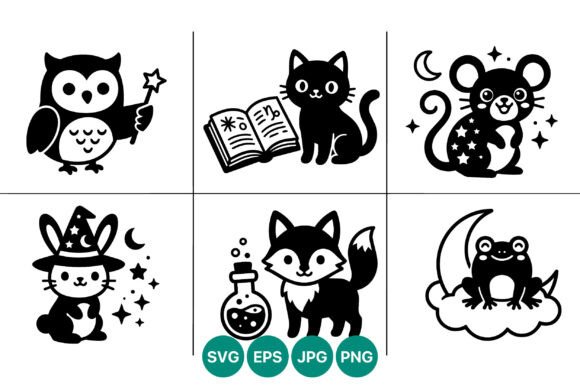
As someone who’s digitized, stitched, and shipped hundreds of embroidery projects—from boutique baby onesies to Etsy best-selling tote bags—I opened Magical Animal Silhouettes Vector Icons expecting whimsy. What I found was something more useful: clean, intentional minimalism with quiet narrative charm. These aren’t busy illustrations; they’re six distinct black-and-white vector icons—owl with wand, cat holding a magic book, mouse beneath moon and stars, rabbit in a witch hat, fox cradling a potion, frog perched on a cloud—each built with confident negative space and balanced silhouette weight. No gradients, no outlines, no overlapping layers. Just strong, stitch-friendly shapes that read clearly at 2–3 inches tall. That matters. A lot.
Where It Shines: Real Projects That Let the Magic Breathe
I tested one icon—the rabbit with the witch hat—on a natural linen tea towel, a midweight cotton sweatshirt, and a lightweight organic cotton baby bodysuit. On all three, it stitched cleanly with standard stabilizer and medium-density fill stitch. The shape held its character without bleeding or distortion. That’s the sweet spot for Magical Animal Silhouettes Vector Icons: products where simplicity reads as intention, not compromise.
- Embroidered patch sets for craft fairs—these icons scale beautifully from 1.5” to 4”, making them ideal for iron-on or sew-on patches sold in themed bundles (e.g., “Enchanted Forest Friends”).
- Tote bag designs for indie bookshops or apothecary boutiques—stitched in matte black thread on oat-colored canvas, the owl or fox reads instantly, adding quiet sophistication without overwhelming the fabric.
- Baby embroidery on burp cloths or crib bands—soft, non-distracting, and gentle enough for nursery decor that avoids cutesy overload.
- Holiday embroidery for handmade ornaments or pillow covers—especially the mouse with moon and stars or frog on a cloud, which lean into subtle seasonal magic rather than overt Halloween or Christmas tropes.
What surprised me? How well these work as digital embroidery files for mockups. Because they’re vector-based and monochrome, they translate crisply into printable mockups for Etsy listings or Instagram product previews—no pixelation, no color shifts, just honest visual clarity.
Where to Pause—and Why
This set isn’t built for every surface or stitch count. As an embroidery designer, I always ask: *What does this design ask of the fabric—and the maker?*
First, avoid using Magical Animal Silhouettes Vector Icons on highly textured fabrics like bouclé or thick terry cloth without heavy cutaway stabilizer. The fine details—the curve of the wand, the open pages of the magic book—can blur if the fabric moves under the needle. Second, skip stretchy knits unless you’re using tear-away + topping combo and reducing stitch density manually. These icons rely on crisp edges; stretch distorts that instantly.
Also, be thoughtful about placement. The frog on a cloud has delicate negative space between toes and cloud edge—tight curves like that can fray on thin fabrics like rayon challis or lightweight chambray. And while the set works beautifully on dark fabric (black thread on navy denim, for example), avoid pairing it with light thread on dark backgrounds unless you’ve tested contrast first—some machines struggle with low-contrast satin stitch definition.
What It Adds to Your Finished Product—Beyond Aesthetics
There’s real value in how these icons land with customers. I added the cat-with-book icon to a small-batch run of embroidered aprons for a local indie bookstore. Buyers didn’t just say “cute”—they said “this feels like *my* kind of magic.” That emotional resonance elevates a handmade product from decorative to meaningful. It builds trust: clean lines signal care in execution; consistent silhouette weight suggests professional digitizing; thematic cohesion (all animals “holding” something magical) supports brand storytelling—even for a solo craft business.
For Etsy sellers and small shop owners, that translates directly to perceived value. A $28 embroidered pillow cover with one of these icons feels more intentional—and therefore more gift-worthy—than a generic floral motif. And because the set is cohesive but not matchy-matchy, it gives room for personalization: pair the rabbit with a custom name script, or use the fox as a subtle accent on a holiday gift tag.
Practical Notes Every Embroidery Designer Should Check
Before stitching your first piece—or listing your first product—take five minutes to verify:
- Test on scrap fabric that matches your final project’s weight and texture—not just muslin.
- Check thread color contrast in both natural and artificial light. Black-on-charcoal can disappear in dim settings.
- Review stitch density in the smallest details—the wand tip, potion rim, star points. Overly dense fills can cause puckering on lightweight items.
- Confirm hoop size compatibility. These icons sit comfortably in 4x4 hoops, but if you’re scaling up for large sweatshirt backs, check whether the file handles expansion without auto-thinning.
- Inspect corners and joins in your embroidery software. Vectors don’t always digitize perfectly—look for unintended overlaps or gaps before sending to machine.
- Use proper stabilizer: medium-weight cutaway for stable wovens, tear-away + topping for knits or delicate surfaces.
- Verify licensing before selling finished items or bundling the digital embroidery file. Since this is categorized as Illustrations and Graphics, confirm commercial use rights apply to physical products and digital resale.
And one last note: these icons thrive when paired with restraint. Let them stand alone—or anchor a simple layout. Don’t over-accessorize with extra fonts or borders. Their strength is in their quiet confidence. That’s what makes Magical Animal Silhouettes Vector Icons more than decoration. It’s a small, thoughtful tool for makers who believe magic lives in the details—and in the stitch.