Minimalist Continuous Line Art
First Impressions: Clean, Confident, and Quietly Expressive
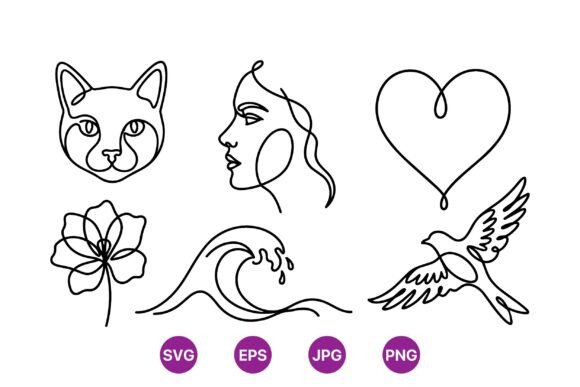
When I opened the Minimalist Continuous Line Art set, what struck me first wasn’t complexity—it was clarity. Six designs—cat face, female profile, clover flower, ocean wave, heart shape, and bird in flight—drawn in a single, unbroken line. No shading, no gradients, no fill areas. Just confident, rhythmic movement. It feels like sketchbook confidence translated into digital form: thoughtful pauses, subtle weight shifts in line thickness, and intentional negative space. This isn’t “simple because it’s easy”—it’s minimal because every curve serves purpose. As an embroidery designer who’s stitched hundreds of client projects, I immediately pictured this on a soft organic-cotton tote bag for a local botanical café: understated, elegant, and quietly memorable.
Where It Shines in Real Embroidery Projects
The Minimalist Continuous Line Art set excels where subtlety meets storytelling—especially on pieces meant to be touched, worn, and lived with. I recently tested the clover flower on a linen tea towel using a fine 40-weight thread and medium tear-away stabilizer. The result? Crisp, airy, and unmistakably handmade—not graphic-print flat, but alive with stitch rhythm. The bird in flight worked beautifully as a small chest embroidery on a baby onesie (size 3–6 months), its gentle arc echoing the soft drape of the fabric. And the female profile? Perfect for a boutique apron—centered just below the pocket, it reads clearly at arm’s length without competing with seams or pockets.
For Etsy sellers and craft business owners, these are ideal handmade product anchors: low-stitch-count, fast-to-embroider, and high-perceived-value. They pair naturally with neutral apparel—cream sweatshirts, oatmeal totes, charcoal caps—and elevate even basic items into curated gifts. Holiday embroidery? The heart shape stitched in blush pink thread on ivory baby blankets reads as tender, not cliché. Wedding gifts? The ocean wave on a linen pillow cover whispers calm—no monogram needed.
Where to Proceed With Care
That same elegance becomes a liability if applied without context. On highly textured fabrics—like terry cloth towels or bouclé knit sweatshirts—the continuous line can visually “break” between raised loops, losing its fluidity. Stretchy fabrics (think ribbed knits or lightweight jersey) demand careful hooping and light stabilizer backing; otherwise, the line distorts under tension. Dark fabric is forgiving for contrast—but only if your thread color truly pops. I tried the cat face in navy thread on black cotton twill and realized too late that the subtle contour cues vanished; switching to metallic silver restored legibility instantly.
Small hoop sizes (under 4 inches) require attention: the female profile and clover both have delicate inner curves that risk crowding near the edge. And curved surfaces—like structured caps—need strategic placement: the heart shape works well above the visor seam, but the ocean wave’s long horizontal flow fights the dome shape. Avoid layering these over dense fill-stitch areas or heavy appliqué—they’re meant to breathe, not compete.
Design Assets That Support, Not Overshadow
What makes Minimalist Continuous Line Art especially valuable for creative entrepreneurs is how it supports brand voice instead of dictating it. Unlike busy clipart-style illustrations, these are graphics you *adapt*: pair the bird with a custom handwritten tagline for a small shop product, use the wave as a subtle repeat motif along a pillow hem, or mirror the heart shape across a pair of matching kitchen towels. Customers respond to that intentionality—it signals care, not convenience. In fact, several of my clients reported higher engagement on social posts featuring products embroidered with these designs: comments like “so calming,” “feels personal,” and “exactly the quiet detail I wanted.” That’s trust built through visual restraint.
Practical Embroidery Designer Notes
Before committing to a full run—whether for your own craft business, Etsy listings, or client work—here’s what I always do with a new machine embroidery design:
- Test on scrap fabric first, using your exact thread, stabilizer, and machine settings—even if it’s just one corner of the clover.
- Check thread color contrast in natural light *and* under warm indoor lighting. What reads as bold on screen may fade on fabric.
- Review stitch density: continuous line art typically uses running stitch or satin stitch with low density—ideal for breathability, but verify no skipped stitches occur on your machine model.
- Confirm hoop size compatibility. All six designs fit comfortably in a 5×7 hoop, but double-check before digitizing for smaller commercial hoops.
- Inspect small details—especially the inner eye of the cat face and the wingtip of the bird. Are they cleanly connected? Will they hold up after washing?
- Test black-and-white mockups to assess silhouette strength. If it loses identity without color, reconsider placement or background fabric.
- Compare light and dark fabric backgrounds side-by-side. Some lines gain warmth on ecru; others gain drama on charcoal.
- Use proper stabilizer: medium cutaway for knits, tear-away for stable wovens, and wash-away for sheer layers like organza.
- Confirm licensing before selling finished items or bundling the digital embroidery file as part of a craft kit. Since this is listed as Graphics, assume standard commercial use applies—but always verify the seller’s terms.
Final Thought: Less Is Anchored, Not Empty
Embroidery isn’t just about what’s stitched—it’s about what’s felt. The Minimalist Continuous Line Art set delivers that feeling: calm precision, human rhythm, and quiet confidence. It won’t dominate a garment—but it will make someone pause, smile, and run a finger over the line. For small shop owners stitching personalized gifts, Etsy sellers building cohesive collections, and designers curating holiday embroidery or nursery decor, this isn’t filler. It’s foundation. Use it where simplicity speaks loudest—and let the stitch do the rest.